
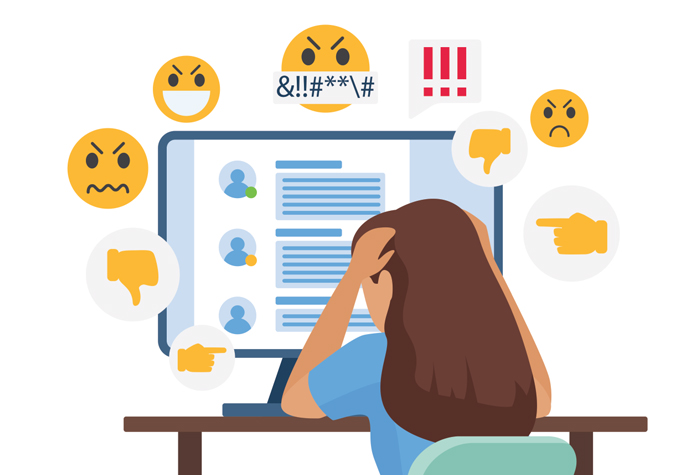
An online petition to make ID verification mandatory to join social media platforms has gathered more than 140,000 signatures in a bid to combat online trolling and abuse. The petition has been launched by celebrity businesswoman and former model Katie Price, after trolls targeted her disabled son Harvey with cruel online taunts.
© Lemberg Vector studio / Shutterstock.com
Price decided to make a stand after social media users hiding behind anonymity directed insults at Harvey, who has Prader-Willi Syndrome, partial blindness, an underactive thyroid and diabetes. She believes people will think twice about trolling others if they can be traced through their verified ID and suffer the consequences.
In the case of under-18s, the petition calls for a parent or guardian to provide ID to open the account to “provide traceability” in the event of an offence and to “prevent anonymised harmful activity”.
Are the proposals feasible?
Some social media platforms have been moving towards a form of verification for users in recent times. Following allegations Russian-based groups targeted American voters through fake social media accounts during the 2016 US presidential campaign, Facebook introduced new regulations requiring any US advertiser placing a political ad to have a United States mailing address.
The social media giant also launched its Page Publishing Authorisation initiative, when the managers of many large Facebook group pages had to complete a verified ID procedure.
Instagram has also introduced similar regulations and requires any individual connected with suspicious behaviour to provide verification of their identity. This is similar to Price’s idea, but relates only to individual cases identified as being suspicious, rather than asking everyone to provide ID as a matter of course.
Price believes expanding the same procedure to all accounts, on every platform, will link a real-world identity to every online persona, leaving people feeling less bold when it comes to leaving abuse for other users. Facing the prospects of legal consequences in the real world could act as a deterrent.
The key question, however, is whether it is feasible to implement the scheme. Facebook alone has almost three billion users, so asking them all to submit ID documents and then verifying them would be massively problematic, not to mention expensive, for the social media giant.
Had ID been a requirement from the outset, it might have been easier, but to implement the controls retrospectively would be extremely challenging, necessitating a significant upgrade in every social media platform’s operations.
Secondly, the impact on every social media platform’s business could be huge. As an example, Facebook currently reports it has 2.8 billion users – a key pull for drawing in advertisers. If each user needed ID verification, it would inevitably lose accounts, as not everyone would be able to provide the required information.
It makes sense that social media platforms will be reluctant to do anything that reduces their own income in terms of decreasing their attractiveness to advertisers.
Would the legislation actually work?
Asking users to submit ID to verify who they are won’t necessarily impact on the trolls, according to research carried out in October 2020. Even if every person had to provide ID, this may not stop online abuse because many adult trolls don’t actually care whether people know who they are.
In the report, Australia’s eSafety Commissioner, Julie Inman-Grant, noted how the trolls they dealt with had high self-esteem and were quite sadistic. They were not interested in hiding their identity and didn’t seem to care if they were recognised or not.
Critics of the scheme have cited the implications of linking people’s offline and online identities, claiming it could impact significantly on freedom of speech – and also on users’ personal protection. There have been suggestions that rather than reducing online abuse, such laws could actually increase real-world violence.
Fears have been raised that abusers could potentially find out where another person on social media lives through their personal information. Civil liberties groups say if the information got into the hands of politically-motivated activists, there could be serious implications.
With data breaches not uncommon on social media sites, it has become a very real fear for people trying to protect their own identity for various reasons. This could include “whistle-blowers” and others who have spoken out, who may feel at risk if their address is included in their data.
It could also affect people who have been subject to domestic abuse, or other acts of violence, who are trying to lie low. There has now been a backlash to Price’s petition, with campaigners wishing to protect the identity of vulnerable people on social media using the hashtag #SaveAnonymity!
Do the negatives outweigh the positives?
It’s difficult to say whether the negative effects of such a change would outweigh the positives. There seems to be logic for both sides of the argument, so it’s impossible to say whether this campaign will succeed or not. Although it’s something all social platforms seem to be considering, it remains to be seen whether it’s a comprehensive solution to online abuse from trolls.
Everyone agrees the trend for online abuse must end, as it causes much mental anguish and distress for victims. While every right-minded person would support someone who had fallen victim to online abuse, such as Katie Price and her son, it is proving challenging to come up with a workable solution.
New research shows around one in three internet users have suffered online harassment. A joint study carried out by senior psychology lecturer Evita March and psychologist Genevieve Steele shows trolling causes “significant distress and harm” to victims.
It can have severe psychological and physical effects including depression, insomnia, low self-esteem, self-harming and even suicide in the most serious cases. Sadly, it is extremely common for people to experience trolling.
Which celebrities have been trolled?
There have been a number of widely reported cases of celebrities being trolled on social media. Price has herself been targeted before the abusers turned on her son. She has spoken of how she dealt with abuse for the biggest part of her career, but when trolls turned on Harvey, it was too much.
Another celebrity who received online abuse was Little Mix singer Jesy Nelson. She received cruel messages on her Instagram account after posting a video of herself dancing with her ex-boyfriend. Nelson, who had already admitted to being bullied at school, wasn’t taking the online abuse lying down. She told critics they were being blocked, adding, “If you don’t like it, don’t look at my Instagram.”
Grammy Award-winning singer Adele was trolled on social media for the green gown she wore for the ceremony. After winning five awards, she hit back with the message, “I don’t care. It was Givenchy Couture, so they can say what they want!”
Canadian singer Justin Bieber threatened to delete his Instagram account after cruel trolls targeted Sofia Richie, his then-girlfriend. He warned them to “stop the hate” and said true fans wouldn’t be “mean” to the people he liked. However, when it continued, he carried through his threat and deleted his Instagram account. He returned to the social media site six months later.
Some people suffer serious psychological effects on their well-being following abuse. It remains to be seen whether the campaign to introduce ID verification on social platforms will become a reality, but the message is simple – play nice!
For professional social media campaigns that attract all the right attention, contact Page1. As a well-established digital marketing agency, our extensive experience enables us to manage effective campaigns, that follow all the right protocols.


